


Never Miss a Post!
Sign up for free and be the first to get notified about updates.
Share Article
Jump To..
The Art of Low & Slow BBQ: Mastering American Smoke Craft
The Art of Low & Slow BBQ: Mastering American Smoke Craft
If you ask most pitmasters what “real barbecue” is, you’ll hear the same phrase over and over: low and slow. It’s the classic American BBQ style built on gentle heat, patient cooking, and deep wood smoke. When you get it right, even tough, gnarly cuts like brisket and pork shoulder turn into slices and shreds of buttery, smoky perfection.
This guide will walk you through everything you need to know to master low & slow BBQ at home—from meat selection and smoker setup to rubs, wood choice, troubleshooting and serving.
Quick Overview
- Low & slow BBQ = 225–275°F (107–135°C) over several hours
- Best for brisket, pork shoulder, ribs, beef ribs, chuck roast
- Use hardwood smoke (oak, hickory, fruit woods) and clean, thin blue smoke
- Season with quality BBQ rubs – salt, sugar, spice, aromatics
- Trust temps + feel more than time: tender meat “jiggles” and probes like soft butter
Rest your meat for at least 1 hour before slicing or pulling
What Does “Low & Slow” Actually Mean?
Low & slow isn’t just a vibe—it’s a set of rules:
- Low temperature: Usually between 225–250°F; some pitmasters run up to 275°F.
- Slow time: Anywhere from 4 to 18+ hours depending on cut and size.
- Indirect heat: The fire is off to the side or below, not directly under the meat.
- Wood smoke: Hardwood or pellets add flavor, color, and aroma.
Low & Slow vs Grilling vs Hot & Fast
Grilling:
- Temp: 400–700°F
- Time: minutes
- Best for: steaks, burgers, chops, kebabs
Hot & Fast BBQ:
- Temp: 300–350°F
- Time: 3–6 hours
- Best for: ribs, smaller brisket flats, chicken
Low & Slow BBQ:
- Temp: 225–250°F
- Time: 6–18 hours
- Best for: brisket, pork shoulder, ribs, beef plate ribs, whole chuck roast
Low & slow shines on big, tough, collagen-heavy cuts—the ones that are too chewy if you cook them like a steak.
The Science: Why Low & Slow Works
Understanding the “why” helps you troubleshoot and improve every cook.
Collagen → Gelatin
Tough cuts (brisket, shoulder) are full of collagen, a tough connective tissue. At low temperatures over long time:
- Around 160–180°F (71–82°C), collagen starts to melt.
- Over hours, it turns into gelatin, which makes the meat juicy and tender.
Cook too hot and the meat tightens and dries out before collagen has time to melt. Cook too short and it’s still chewy.
Fat Rendering
Marbling (fat inside the meat) slowly renders as the meat climbs through the 150–200°F range. That rendered fat:
- Lubricates the meat fibers
- Carries and intensifies seasoning
- Contributes to that luscious mouthfeel
Smoke, Bark & the Smoke Ring
- Smoke: The best flavor comes from thin, almost invisible blue smoke. Thick white or grey smoke often means smoldering wood and bitter flavor.
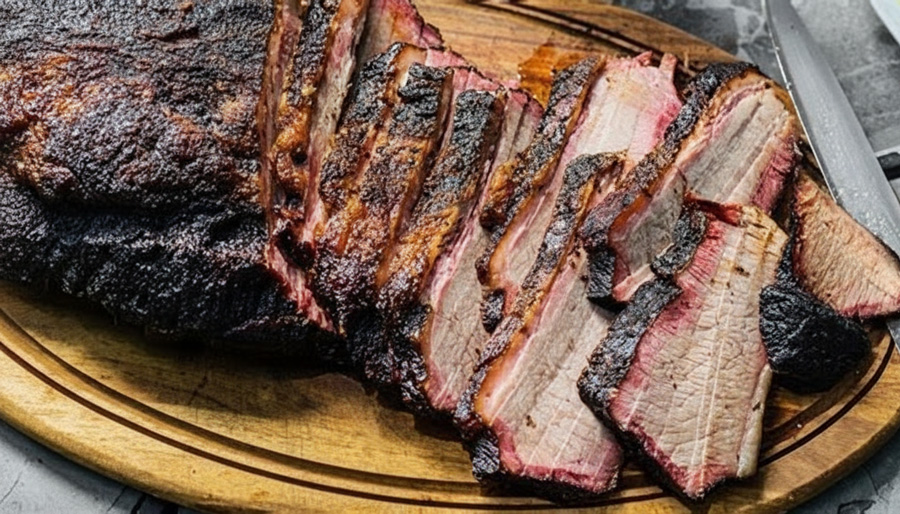
- Bark: The dark crust on BBQ forms from the rub, smoke, and surface drying. Good bark is flavorful, slightly chewy, and full of concentrated seasoning.
Smoke ring: That pink halo under the bark is a reaction between smoke compounds and myoglobin in the meat. It looks great, but it’s cosmetic—flavor matters more.
Choosing the Right Meats for Low & Slow
Not every cut is built for long hours of smoke. Here are classic low & slow heroes and what to look for.
Brisket
The king of Texas BBQ and the ultimate test of low & slow skill.
Type: Whole “packer” brisket with both point and flat attached (10–18 lbs)
What to look for:
- Good marbling throughout
- Thickest point about twice the thickness of the flat
- When you bend the brisket in the store, it should have some flex
Pork Shoulder / Boston Butt
Arguably the best beginner cut for low & slow.
Weight: 7–10 lbs bone-in
Why it’s great:
- Tons of connective tissue = hard to overcook
- Forgiving on timing
- Shreds beautifully for pulled pork sandwiches or tacos Ribs
Both pork ribs and beef ribs love low & slow.
- Baby back ribs: Meatier, cook a bit faster (4–5 hours).
- Spare/St. Louis ribs: More fat and flavor, 5–6+ hours.
- Beef plate ribs: Huge, dinosaur-style ribs with intense beefy flavor.
Other Great Cuts
- Chuck roast (like “poor man’s brisket”)
- Whole packer tri-tip (lower & slower than traditional Santa Maria style)
- Lamb shoulder
When in doubt, think: tough, well-marbled, and full of connective tissue.
Setting Up Your Smoker for Low & Slow
Whatever cooker your reader owns, they should leave this post confident they can hit 225–250°F and keep it there.
Offset Smoker
Offsets are the classic “stickburner” pits: firebox on one side, cooking chamber on the other.
- Build a small charcoal bed in the firebox.
- Add one or two small hardwood splits (oak, hickory, etc.).
- Leave both intake and exhaust vents fully open at first.
- Once the fire is burning clean and the smoker is around 225–250°F, throttle the intake vent slightly to stabilize.
- Add a new split when temps dip (usually every 30–45 minutes on budget pits).
Pellet Smoker
Pellet grills are ideal for beginners and busy cooks.
- Set the temp (225–250°F).
- Fill the hopper with quality pellets.
- Let the controller feed fuel and maintain temp automatically.
You still need to position the meat, watch internal temps, and use good rubs—but pellet smokers dramatically simplify the fire.
Kettle Grill (Charcoal)
Almost any backyard kettle can become a smoker.
- Arrange charcoal in a “snake” or “C” shape around the edge.
- Light one end of the snake so it burns slowly.
- Place a drip pan with water under the grate in the center.
- Put your meat above the pan (indirect zone).
- Add a few chunks of wood along the snake.
Control temps mostly with top and bottom vents: more open = hotter, more closed = cooler.
Kamado (Ceramic)
Kamados are incredibly efficient:
- Use a small amount of lump charcoal.
- Add a few wood chunks.
- Install the heat deflector for indirect cooking.
Start with vents barely open and adjust slowly—they respond quickly and hold heat for hours.
Wood, Charcoal & Flavor Pairings
A quick primer you can reuse in multiple posts and cross-link internally.
Charcoal Choices
- Lump charcoal: Burns hot and clean, more responsive to vent changes.
- Briquettes: Burn more consistently and are easier for long cooks.
Wood Types
- Oak: Balanced, classic BBQ flavor; perfect base wood for brisket & beef.
- Hickory: Strong, bacon-like flavor; great on pork, but can be heavy if overused.
- Pecan: Slightly sweet, softer than hickory, excellent for pork and poultry.
- Fruit woods (apple, cherry, peach): Mild, slightly sweet smoke; beautiful color on ribs and pork.
- Mesquite: Very strong; best used sparingly or mixed with oak.
Simple pairing rule:
- Beef & lamb → oak, mesquite (light), hickory
- Pork → hickory, pecan, apple, cherry
- Poultry → fruit woods, pecan
Step‑by‑Step: Low & Slow Brisket
1. Trim the Brisket
- Remove hard, waxy fat from the surface.
- Leave about ¼ inch of fat on the fat cap.
- Round off thin corners that will dry out.
2. Dry the Surface
Pat the meat dry with paper towels so rub sticks evenly.
3. Season Generously
Use:
- A simple beef-focused blend with coarse salt, black pepper, and garlic.
- Or a competition-style brisket rub that layers pepper with paprika, onion, and a subtle sweetness.
Don’t be shy with the rub—brisket is thick, and a generous coat builds better bark.
4. Preheat the Smoker
- Target 225–250°F before the brisket goes on.
- Make sure your smoke looks thin and blue, not thick and white.
5. Smoke, Unwrapped
- Place the brisket fat-side up or down depending on your pit’s heat source.
- Close the lid and avoid peeking.
- Spritz with a 50/50 mix of apple juice and water (or beef broth and water) only after the bark has started to set—usually 3–4 hours in.
6. Manage the Stall
At around 150–170°F internal, you’ll hit “the stall,” where the temp plateaus and may even drop. This is normal: moisture evaporation is cooling the meat as fast as heat is entering.
You have two options:
a. Ride it out (unwrapped): produces the firmest bark, takes longer.
b. Wrap the brisket (“Texas crutch”): use unwaxed butcher paper or foil once bark is dark mahogany and doesn’t scrape off easily.
- Wrapping shortens the stall and helps retain moisture.
- Butcher paper preserves bark better than foil.
7. Finish to Tender, Not Just Temp
Use temperature as a guide, not a finish line.
- Most briskets finish between 200–210°F internal in the thickest part of the flat.
- Probe with a skewer or thermometer: you’re looking for soft-butter tenderness everywhere, including the flat.
If it still feels tight or resistant, keep cooking—even if the number “looks right.”
8. Rest Properly
Resting is just as important as cooking.
- Vent steam for a few minutes after pulling from the smoker.
- Then wrap tightly (if not already wrapped) and rest in a cooler, warm oven, or insulated box for at least 1 hour, up to 3–4 hours.
This allows juices to redistribute and the meat to relax.
9. Slice & Serve
- Separate the point from the flat along the natural fat seam.
- Slice against the grain in pencil-thick slices.
- On the flat: long, straight slices.
- On the point: rotate 90° and slice across the grain.
Rubs & Seasonings: How to Choose for Low & Slow
The Four Building Blocks of a BBQ Rub
- Salt – opens up flavor and helps with moisture retention.
- Sweetness – usually from sugar; enhances bark color and caramelization.
- Heat – from black pepper, chili powders, cayenne, etc.
- Aromatics & Herbs – garlic, onion, paprika, cumin, herbs.
Rub Strategies by Meat
Brisket:
- Go heavier on coarse salt and black pepper.
- Consider rubs marketed “for beef / brisket / steak” with robust savory notes.
Pork Shoulder & Ribs:
- Sweet + smoky rubs with brown sugar, paprika, and mild heat.
- Fruit-forward rubs (cherry, apple, honey) are especially popular.
All-Purpose:
- A good all-purpose rub is ideal for readers just starting out.
- Suggest they keep at least one AP rub on hand for chicken, veggies, and sides.
Time & Temperature Guide (Cook by Feel, Not by Clock)
At 225–250°F, rough time estimates are:
- Brisket (whole packer, 12–15 lbs): 12–18 hours
- Pork shoulder / Boston butt (7–9 lbs): 8–14 hours
- Baby back ribs: 4–5 hours
- Spare/St. Louis ribs: 5–6+ hours
- Beef plate ribs: 7–9 hours
Barbecue is done when it’s tender, not when the timer beeps.
Use:
- A good dual‑probe thermometer (chamber + meat)
- The probe test (slides in like soft butter)
- The jiggle test (brisket jiggles when picked up or nudged)
Common Mistakes (and How to Fix Them)
- Bitter, Harsh Smoke
Problem: Food tastes acrid or like an ashtray.
Causes:
- Wood is wet or moldy
- Fire is choked (not enough airflow)
- Too many wood chunks/splits at once
Fix:
- Use seasoned hardwood.
- Keep exhaust vent fully open; control temps with intake.
- Aim for a small, clean fire, not a big smoldering log.
- Dry Brisket or Pork
Possible causes:
- Pulled too early, before collagen fully broke down.
- Cooked too hot for too long.
- Not enough fat/marbling in the cut.
- Skipped or rushed the rest.
Fix:
- Cook until probe-tender, not just at a certain temp.
- Buy higher-quality, well-marbled cuts.
- Always rest, wrapped, for at least an hour.
- Rub Turning Black or Burned
A dark bark is normal, bitter burnt rub is not.
- If using high-sugar rubs, consider slightly higher cooking temps (250–265°F) but shorter time, or wrap earlier once color is where you want it.
- Don’t place meat too close to your heat source.
- Ribs That Are Mushy or Falling Apart
The old idea that ribs should “fall off the bone” often leads to overcooked, mushy ribs.
Aim for:
- Meat that bites cleanly off the bone with a slight tug.
- If bones twist with almost no resistance, you probably went too far.
Serving, Holding & Leftovers
Low & slow cooks often finish before guests arrive—or way after. Planning for holding and leftovers makes your readers’ lives easier.
Holding Cooked Meat
- For brisket and pork shoulder, holding wrapped in a warm cooler or insulated box for 2–4 hours actually improves texture.
- Keep wrapped in butcher paper or foil, placed in a towel-lined cooler.
Serving Ideas
- Brisket: sliced with pickles, onions, and simple white bread.
- Pork shoulder: pulled and piled on buns with slaw.
- Ribs: cut into singles or doubles and served with a light glaze.
Leftover Gold
- Brisket grilled cheese
- Pulled pork tacos or nachos
- Smoked meat chili or stew
- Breakfast hash with smoked pork
Tools & Accessories That Make Low & Slow Easier
- Probe thermometers and wireless temp monitors
- Heat-resistant gloves
- Spritz bottles
- Injection needles for pork shoulders
- Drip pans and water pans
- Grill brushes and cleaning tools
FAQ: Low & Slow BBQ
Q1. What temperature is considered “low and slow” for BBQ?
Most pitmasters consider 225–250°F to be the classic low & slow temperature range. Some cooks go up to 275°F, but anything beyond that drifts into “hot and fast” territory.
Q2. How long does it take to cook brisket low and slow?
At 225–250°F, a full packer brisket usually takes 12–18 hours, depending on size, marbling, and your specific smoker. Always cook until the meat is probe-tender, not just when it hits a certain internal temp.
Q3. Do I need to wrap meat during low & slow BBQ?
You don’t have to, but wrapping (in butcher paper or foil) helps:
- Push through the stall faster
- Retain moisture
- Soften the bark slightly
Unwrapped gives the firmest bark and the strongest smoke flavor but may take significantly longer.
Q4. What wood is best for low and slow BBQ?
There’s no single “best” wood, but oak is a great all-around choice, especially for brisket. Pair oak or hickory with fruit woods (apple, cherry) for pork ribs and shoulder.
Q5. What’s the easiest meat for beginners to smoke low and slow?
Pork shoulder / Boston butt is the most forgiving. It has plenty of fat and connective tissue, and it still tastes great even if you overshoot the perfect finish by an hour or two.
Q6. Do I need a fancy smoker to cook low and slow?
No. You can cook low & slow on an offset smoker, pellet grill, kettle grill, kamado, or even some gas and electric smokers. As long as you can maintain steady indirect heat and generate clean smoke, you can make excellent BBQ.